
 +86-18378303768
Why Instructors Recommend Specific Spring Loads (It’s Not Just About “Challenge”)
Protect your form: Lighter springs often force you to engage your core, stabilize your joints, and focus on slow, controlled movement—all non-negotiables in Pilates. Heavier springs can make it tempting to “muscle through” moves (using brute strength instead of intentional engagement), which skips the muscle activation and alignment work that makes Pilates effective. For example, a lighter spring during footwork encourages you to use your glutes and hamstrings, while a heavier spring might let you rely on your quads alone.
Target specific muscles: Different spring loads isolate different muscle groups. Instructors pick resistance that hones in on the muscles the exercise is designed to work—whether it’s your deep core, posterior chain, or upper back. Upping the spring arbitrarily could shift the focus away from those target muscles, making the move less effective.
Prevent overuse injuries: Even strong bodies need time to adapt to Pilates’ unique movement patterns. Lighter springs allow your joints (especially your shoulders, hips, and spine) to build stability gradually, reducing the risk of straining muscles or joints by pushing too hard too soon—even if you feel strong enough for more resistance.
Align with class goals: Group classes often use specific spring loads to keep everyone on the same page, focus on a particular skill (like control or balance), or cater to the average skill level of the class. Your instructor’s recommendation isn’t just for you—it’s for the collective flow of the session.
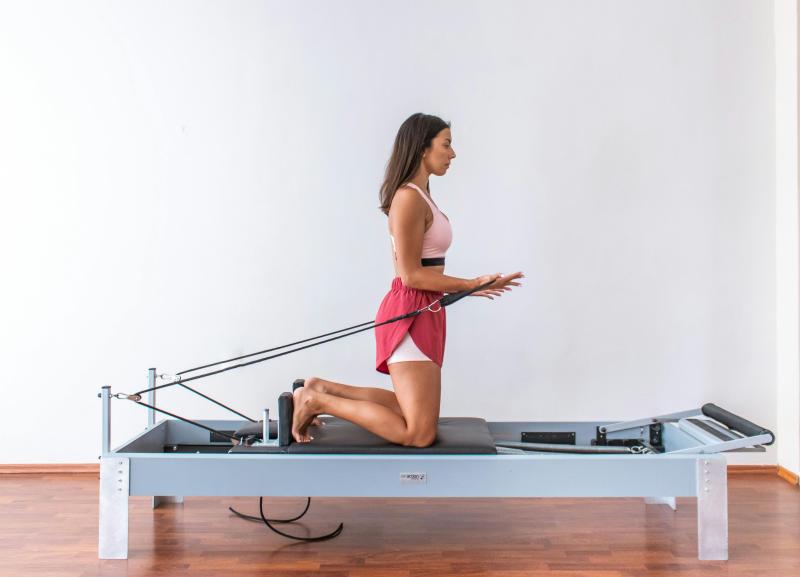
When It’s OK to Up the Spring Load (3 Key Conditions)
1. You Can Maintain Perfect Form (No Exceptions)
2. You’re Familiar with the Exercise (No New Moves!)
3. You’re Not Compensating for Weakness
When to Stick to Your Instructor’s Guidance
When the focus is on control, not strength: Many Pilates moves are designed to build control, balance, or flexibility—not raw strength. Lighter springs force you to slow down and engage the right muscles, which is more valuable than adding resistance.
During group classes (unless told otherwise): If your instructor says “everyone use two springs,” it’s for a reason—usually to keep the class aligned or focus on a specific skill. If you want to adjust, ask your instructor before class (more on that below).
When you’re recovering from soreness or tightness: Even strong muscles need recovery. If you’re feeling sore from a previous session, stick to the recommended spring to avoid overworking your body.
When the move targets a weak area: If the exercise is designed to build strength in a muscle group you struggle with (e.g., core or glutes), lighter springs will help you isolate that muscle without compensating.
Pro Tips for Adjusting Spring Load Safely
Go gradual: Don’t jump from one spring to three—add one spring at a time. This lets you test if you can maintain form and avoid overexertion.
Ask your instructor first (when possible): Before class, mention to your instructor: “I’ve been practicing for two months, and I feel strong enough to add a spring to some foundational moves—would that be okay?” Most instructors will appreciate your initiative and give you personalized guidance (e.g., “Stick to light for core moves, but you can add one for leg work”).
Focus on quality over quantity: Even with added resistance, prioritize slow, intentional movement. Pilates is about control, not how much weight you can pull—heavier springs mean nothing if your form suffers.
Listen to your body: Soreness is normal, but sharp pain, joint discomfort, or fatigue that makes you compensate is a sign you’ve gone too far. Dial the spring back if you feel any of these.


 +86-18378303768