
 +86-18378303768
Joe Pilates’ Original System—Why the Full Apparatus Arsenal Matters
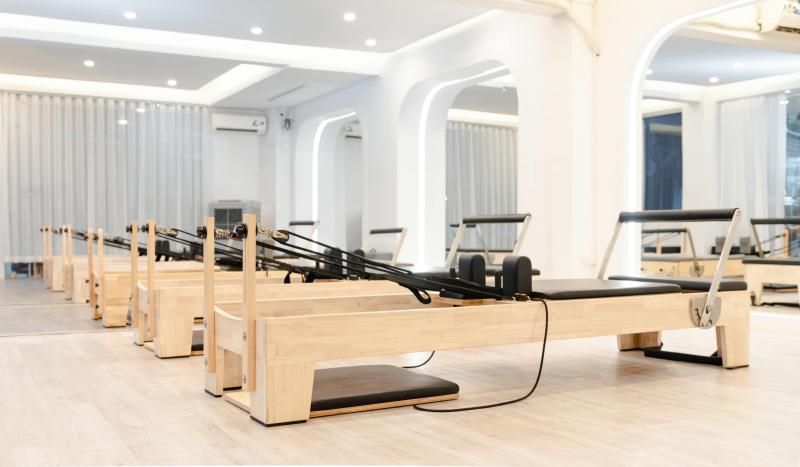
Cadillac (Trapeze Table): The “Swiss Army knife” of classical Pilates—adds vertical movement, suspension, and resistance for spinal extension, shoulder mobility, and core stability (addresses the forward-rounded postures Joe Pilates saw in his early clients). It’s the only apparatus that lets practitioners move in suspension, building anti-gravity strength critical for full-body control.
Spine Corrector/Barrels (Ladder Barrel, Arc Barrel): Specialized for spinal articulation—unlocking stiff vertebrae, improving lateral flexion, and building spinal mobility without compromising core control. Mat work can target spinal flexion, but barrels/correctors are irreplaceable for safe, supported extension and rotation (a common weak spot in single-apparatus practice).
Wunda Chair (Combo Chair): Compact but powerful—builds functional, weight-bearing strength (far more than reformer) for the lower body, core, and upper body, with a focus on quick, controlled movements that translate to daily life (e.g., standing, lifting, walking). It’s the bridge between apparatus work and real-world movement.
Springboard: A reformer/Cadillac attachment (or standalone) that adds dynamic upper body and core work—refining precision and control for small, stabilizing muscles that are overlooked in larger reformer/Cadillac moves.
What a Full-System Classical Pilates Class Looks Like (Boutique Studio Edition)
Core Rule: Instructors Choose Equipment Based on Purpose, Not Checklists
Focal Point: Spinal Articulation & Mobility: Mat work (cat-cow, single-leg stretches) → Spine Corrector (lateral bends, spinal rolls) → Ladder Barrel (supported spinal extension) → Reformer (supine spine stretches with light springs) → Mat cool down (breath work).
Focal Point: Full-Body Functional Strength: Mat work (hundred, roll-up) → Wunda Chair (squats, arm presses) → Reformer (footwork with heavy springs, lunges) → Cadillac (suspension leg lifts) → Mat cool down (side-lying stretches).
Focal Point: Shoulder Mobility & Upper Body Control: Mat work (swimming, superman) → Cadillac (trapeze arm work, suspension chest openers) → Springboard (reformer-attached arm presses) → Wunda Chair (standing arm work) → Mat cool down (shoulder stretches with breath).
“Joe Pilates taught private sessions, so the full system is most personalized one-on-one—but for small groups, we pick a focal point that aligns with the group’s shared needs (e.g., most of our morning clients are desk workers, so we focus on spinal mobility and shoulder openers). We never jump from Cadillac to barrel to chair just to ‘hit everything’—it’s a flow. Apparatus moves build on each other, and mat work is the glue that brings it all back to centering and breath. A 60-minute group class might use 3–4 pieces of equipment, plus mat—never all 6. The goal is integration, not quantity.”
Private Sessions: The True Full-System Experience (Tailored to the Individual)
If a student’s lower back is stiff: Spine Corrector → Ladder Barrel → Reformer (supine spine work) → mat cool down.
If a student is recovering from a shoulder injury: Cadillac (gentle suspension arm work) → Springboard (light arm presses) → mat (prone shoulder stretches) → Wunda Chair (lower body work to avoid overtaxing the shoulder).
If a student wants to build functional strength for running: Wunda Chair (squats, lunges) → Reformer (fast footwork with medium springs) → Cadillac (suspension leg lifts) → mat (core stability work).
How Studios Balance Apparatus Exposure Across the Week (Not the Class)
Related cases
Contact Us
Tel:+8615818656741 Whatsapp:+8618378303768 Email:info@mieuxpilates.com
Website column
Our strengths
-
Material
Mieux Pilates uses premium materials

-
Transportation
Mieux Pilates provides global transportation

-
Warranty
Our Pilates products have a 3-year warranty.

Friendship link:
All rights reserved by mieuxpilates
Guangdong ICP No. 12037206
technical support:Mieux Pilates +86-18378303768